
What are the three big problems in fashion? And what can you do to avoid them? Practical tips and resources to help you on your way.
The Speaker – Madelyn Postman

Madelyn Postman is Joint Managing Director of Grain Sustainability, a B Corp with the mission to help organisations champion people and the planet. With a background in branding and communications (including five years at Gucci Group), Madelyn has an affinity for education tools like Carbon Literacy training and Climate Fresk, an interactive 3-hour workshop to learn the science behind climate change.
As a business member of 1% for the Planet, Grain gives 1% of its revenue to approved environmental nonprofits. Madelyn is on the board of 1% for the Planet as its first non-US-based board member.
Recently, Madelyn was appointed the London Ambassador for the Better Business Network, which connects and supports purpose-driven businesses. In her free time, she is writing a short story collection that links memoir with her family’s intergenerational tale: the tragedies and triumphs of Chinese and Eastern European Jewish immigrants to California.
The Talk
Madelyn covered these important topics for anyone who wears clothes!
What are the three big problems in fashion?
1. Resources. For example, it takes 2,000 gallons of water to make a single pair of jeans.
2. Waste, emissions and pollution. Over-supply in the industry means that about 40% of garments made are not even sold. Supply chains are hidden and 85% of clothes find their way to landfill or to the Atacama Desert in Chile!
3. Human Rights. Brands often exploit their workers
And the three solutions
- Buy fewer new clothes. Sounds easy but breaking habits can be hard. Buy second hand from online outlets such as Thrifted, Beyond Retro and Vinted. You can sell stuff you don’t wear through them too. Choose plastic-free fabrics that use as little resource as possible. Top of the list are hemp, linen and recycled cotton. If you want to find out about brands and their ethical rating, look up Ethical Consumer and Good on You.
2 Care for your clothes. Wash them only as often as they really need, capture microplastics with a guppy friend, and try creative mending methods such as Japanese sashiko:
Sashiko is a Japanese stitching style that was originally used by working class people as a means to mend used clothing and household items. But it is so much more than that! The even, geometric patterns of sashiko create a beautiful decorative effect
3. Share clothes. With friends of course, but there are websites for that too such as Hurt and some high street retailers including Selfridges and John Lewis have introduced rental schemes.
When you buy new, do some research. Look up the retailer’s ethical score. Do they offer a mending service? Check the label for plastics.
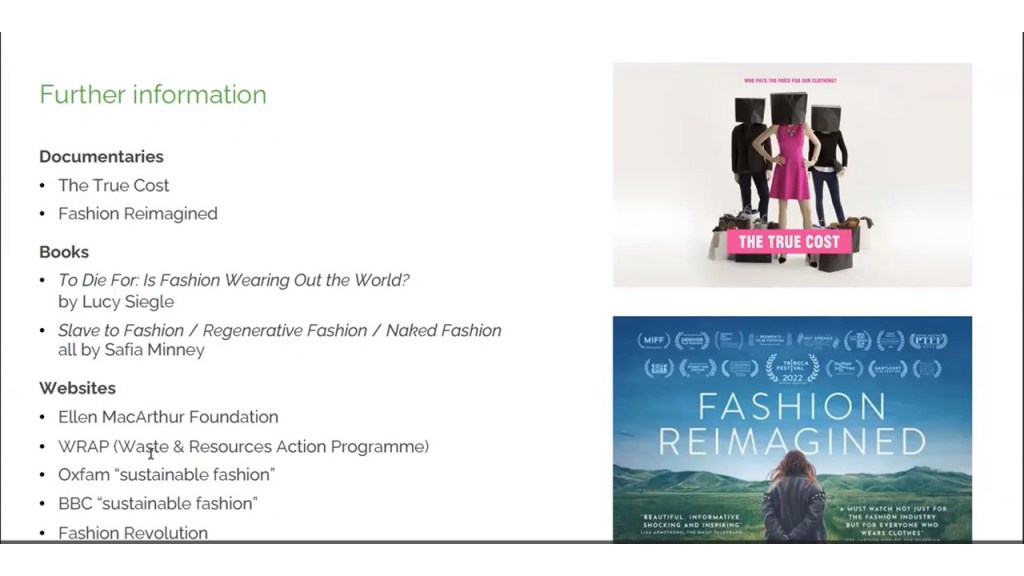
Madelyn also explained the circular economy. This goes further than recycling by building re-use of materials into the design process. Information on https://www.ellenmacarthurfoundation.org/. What about digital clothes? Yes, really.
A local group in Amersham, Bucks actively promoting sustainable habits and running a repair cafe: sustainableamersham.org There may be similar groups near where you live.
 Speak up for our Planet
One thought on “Sustainable Fashion”